
 TAB Argentina
 TAB Australia
 TAB Austria
 TAB Canada
 TAB Chile
 TAB Czech Republic
 TAB England
 TAB France
 TAB Germany
 TAB India
 TAB Ireland
 TAB Israel
 TAB Lichtenstein
 TAB Mexico
 TAB Moldova
 TAB Netherlands
 TAB New Zealand
 TAB Paraguay
 TAB Portugal
 TAB Romania
 TAB Scotland
 TAB Slovakia
 TAB South Africa
 TAB Spain
 TAB Switzerland
 TAB United States
 TAB Wales
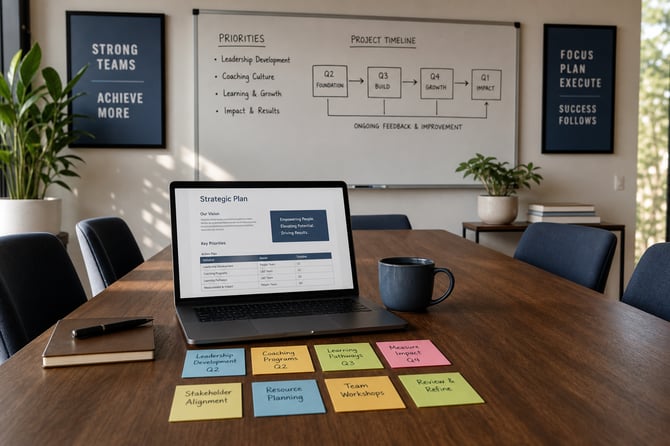
To update a strategic plan that has gone stale, pull the existing document and mark what the business has proven right or wrong. Decide whether you need a light refresh or a full reset. Then revisit your core choices, reset priorities against real capacity, and rewrite each initiative with one owner and a date. Most plans go stale because they sit on a shelf and get a once-a-year glance, so the fix is making the plan a working tool again.
Signs Your Strategic Plan Has Gone Stale
Pull out the plan and set a ten minute timer. You are looking for drift. A plan loses traction long before anyone admits it, and the signals are easy to spot once you know them.
- Shelf-plan behavior: nobody can name the top three priorities without opening the doc.
- Recurring fire drills: the same urgent issues hijack the week, every week.
- Frozen priorities: the priorities page looks identical to last quarter, even though the market moved.
- Workarounds: teams build their own trackers, meetings, and targets around the plan.
- Decision fog: big calls get made on gut feel because the plan offers no clear tradeoffs.
- Owner bottleneck: everything routes to you because the plan does not guide choices.
See three or more of these and the plan has stopped doing its job. Time to update it.
Refresh or Reset: Decide the Scope First
Before you touch the document, pick the scope. A light refresh fixes a plan that mostly still fits. A full reset rebuilds one that no longer matches reality. Get this call right and you save hours.
| Refresh when | Reset when |
|---|---|
| Your goals still fit the market | Your market, model, or buyer changed |
| You missed targets on execution | You missed targets because assumptions broke |
| Priorities stay mostly right | Priorities fight each other across teams |
| You need updated numbers, owners, and dates | You need new choices on where to play and how to win |
A refresh means you edit the existing pages, then update metrics and timelines. A reset means you pause edits, re-check your core choices, and rebuild the document around them. If you are starting from a blank page, writing a strategic plan from scratch is a different job with its own steps.
Mark What the Plan Got Wrong, Then Update Your Reality File
Open the existing doc and work through it once. Do not start fresh. Mark every assumption and big bet with one label, then build a short reality file that captures what actually changed.
- Keep
- Still true, still driving results.
- Edit
- Direction holds, the details changed.
- Delete
- Proven wrong by reality.
- Unknown
- Needs a quick test or a data pull.
Hit the areas that drift fastest first:
- Target markets and buyer needs
- Pricing and margin assumptions
- Channels that used to work, such as referrals, ads, partners, and outbound
- Capacity limits across people, time, cash, and systems
Your plan went stale because the market moved, so capture the shift on one page. Which offers now get replies, referrals, and faster closes? Ask ten recent losses one question, "What changed?", and track the themes in their words. Note any competitor moves and the do-it-yourself or in-house options buyers mention. You are testing the same core elements of a strategic plan against what the business has proven since you wrote them.
Revisit the Few Choices That Drive Everything Else
Most stale plans fail at the decision layer first. Four choices carry the rest. Get them clear and in writing before you touch priorities.
- Where to play
- The markets, customer types, geographies, and channels you will focus on.
- How to win
- The few things you do better than the alternatives, tied to price, service, speed, expertise, or outcome.
- What you will stop
- The offers, segments, and internal projects that drain time and attention. Put it in black and white.
- What you will fund
- The one to three bets that get people, time, and budget first.
If these four lines feel fuzzy, the plan already drifted. Growth is rarely just a marketing problem. Brand, sales, operations, and leadership all have to move together, so check all four before you blame the funnel.
Reset Priorities With a Tradeoff Filter
A stale plan usually says yes to everything, so nothing moves. Force the tradeoffs. Score each initiative on five factors, then cut the bottom, even the ones that feel strategic.
| Factor | What you are judging |
|---|---|
| Impact | Revenue, margin, retention, or delivery quality |
| Effort | People-hours, complexity, coordination |
| Time to value | How fast you see results |
| Risk | Execution risk plus the downside if you are wrong |
| Capacity fit | Whether it matches your real bandwidth this quarter |
Score five to ten initiatives from 1 to 5 on each factor, add up the totals, and rank them. Then rewrite the priority list around the top few.
Rewrite Each Initiative so It Reads Like Work
Stale plans hide behind fuzzy verbs like improve, enhance, and grow. Turn each initiative into a work order with a clear outcome, one owner, a first checkpoint, and a budget range.
- Outcome
- What changes, by how much, and by when.
- Owner
- One name, one person accountable.
- First milestone
- A deliverable you can see in 30 to 45 days.
- Budget range
- A rough band, from zero to over 25k.
- Dependencies
- One line, at most.
Rewrite every initiative the same way, then lock owners and dates. If your team runs on OKRs, this format drops straight into them while staying readable in plain English.
Keep the Plan From Going Stale Again
A plan goes stale when the world shifts and nobody writes down what changed. Two habits keep the refresh alive without turning into a monthly chore: a short assumptions log and a review rhythm you actually hold.
| Assumption | Why it matters | Signal to watch | Review date |
|---|---|---|---|
| Top three customers renew at current rate | Protects cash flow and staffing | Renewal rate dips, payment delays rise | 30 days |
| Lead costs stay within target | Keeps the growth math real | Cost per lead spikes, close rate drops | 60 days |
Cap it at ten to fifteen assumptions, with one owner per row. Then set the rhythm:
- Quarterly mini refresh, 60 to 90 minutes: update assumptions, top priorities, and the three to five moves that matter now.
- Annual deeper review, half a day: re-cut direction, resource bets, and tradeoffs. Keep what works. Rewrite what aged out.
Put both on the calendar as recurring meetings before you close the document. A steady strategic planning cadence, run with your leadership team, keeps the direction current and the plan off the shelf.
The strategic planning really helped me stay accountable to meeting long-term goals that I might have otherwise put off.
Frequently Asked Questions
- How often should you update a strategic plan?
- Update it in a light refresh every quarter, with a deeper review once a year. A 60 to 90 minute quarterly check keeps priorities current, while the annual review re-examines your direction and resource bets. Plans that only get an annual glance drift for months before anyone notices.
- What is the difference between refreshing and resetting a strategic plan?
- A refresh edits a plan that mostly still fits: you update numbers, owners, and dates. A reset rebuilds a plan whose core assumptions broke, so you re-check where to play and how to win before touching the pages. Scope the call first to avoid wasted effort.
- What are the signs a strategic plan is out of date?
- The clearest signs are a plan nobody can quote from memory, priorities that never change, the same fires every week, and big decisions made on gut feel. When teams build their own trackers around the plan, it has stopped guiding the work and needs an update.
- How long does a strategic plan refresh take?
- A focused refresh takes about a day of real work: two hours to prep clean inputs, a half-day working session to update priorities and owners, and an hour to finalize the document. Keeping the group small, four or five people, is what keeps it that fast.
- Who should be involved in updating a strategic plan?
- Keep the group to the owner or CEO, plus the operations, sales, and finance leads. A small room makes faster, cleaner decisions. Bring the current plan, the last 90 days of results, and a short list of the decisions the session needs to settle.