
 TAB Argentina
 TAB Australia
 TAB Austria
 TAB Canada
 TAB Chile
 TAB Czech Republic
 TAB England
 TAB France
 TAB Germany
 TAB India
 TAB Ireland
 TAB Israel
 TAB Lichtenstein
 TAB Mexico
 TAB Moldova
 TAB Netherlands
 TAB New Zealand
 TAB Paraguay
 TAB Portugal
 TAB Romania
 TAB Scotland
 TAB Slovakia
 TAB South Africa
 TAB Spain
 TAB Switzerland
 TAB United States
 TAB Wales
A small business can only grow as fast as its leaders can lead.
If you feel like you carry the business in your head — every decision, customer issue, hiring call, and quality check — that is a leadership capacity problem, not a hustle problem. A leadership development plan gives you a simple, repeatable way to build that capacity in yourself and your team, so the business runs better without you holding every lever.
This guide will show you how to create a leadership development plan for small business owners that fits real life: limited time, tight budgets, and roles that overlap. You will leave with a clear path to develop owners, managers, and emerging leaders, without turning your company into a corporate training program.
What a Leadership Development Plan Is (and Why Small Businesses Need One)
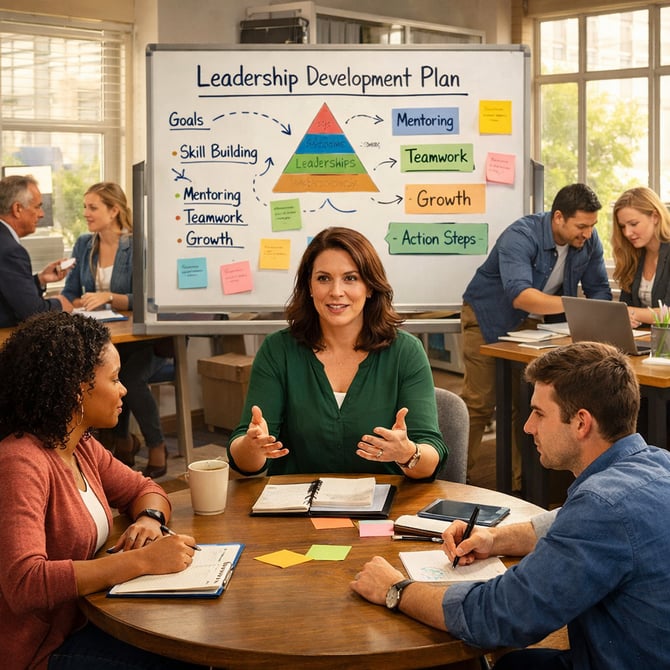
A leadership development plan (LDP) is a structured approach to building leadership skills so people can step into stronger roles over time. It turns “we need better leaders” into specific skills, actions, and checkpoints, replacing hope with a plan.
Who a Leadership Development Plan Is For
Even in a company with 8, 18, or 40 people, leadership shows up everywhere. A practical leadership plan for employees usually covers three groups:
- Small business owners who need to lead strategy, culture, and results without staying stuck in daily firefighting
- Managers and supervisors who run day-to-day work and set the pace for performance
- Emerging leaders — your “go-to” people who influence others now, even without a manager title
- Better retention: When people see growth paths and get consistent feedback, they stay longer and feel seen.
- Cost savings: Fewer bad hires, fewer avoidable mistakes, less rework, and less owner “hero time.”
- Stronger results: Leadership development works best when it supports business goals.
Small businesses rarely struggle because of a lack of effort. They struggle because leadership responsibility sits with too few people.
What a Leadership Development Plan Includes
A strong small business leadership development plan requires clarity, not fancy software. Most LDPs include:
- Target roles — owner, team lead, manager, future manager
- Leadership competencies your business actually needs (not someone else’s generic list)
- A current skill baseline — what people do well now and where the gaps are
- Development actions — projects, coaching, practice, feedback loops
- Cadence and accountability — who checks progress, and when
The goal is practical: prepare people for leadership roles by building real competencies that match your business needs.
Why Small Businesses Need a Leadership Development Plan
In a small company, one weak leadership link costs more than it does in a large one. When leadership stays informal, the patterns that follow are predictable: the owner becomes the bottleneck for decisions, managers do the work instead of leading it, high-potential employees leave because they cannot see a future, and standards slip because nobody owns coaching and accountability.
A leadership development plan helps you fix those issues before they become crises. The business outcomes are real:
The Real Goal: Reduce Owner Dependence Without Losing Control
A good LDP gives you more control with less effort. Expectations become clear, decisions move to the right level, and managers handle performance earlier, before it turns into a crisis. If you want your business to scale, sell, or simply feel calmer, build leaders on purpose.
If you say yes to two or more of the following, start your plan this quarter:
- You are the hub for every decision, and things stall when you step away
- You promote strong individual contributors who then struggle as managers
- You lose good people and feel surprised when they quit
- You see inconsistent customer experience across team members
- You avoid hard conversations until problems turn expensive
What Good Looks Like When the Plan Is Working
A working leadership development plan shows up in everyday operations, not in training completion reports. Look for these signs:
- Managers run solid one-on-ones without you prompting them
- Projects move forward without constant follow-up from the top
- Team members solve more problems on their own
- You spend more time on growth and less time on firefighting
If those sound far off right now, that gap is exactly what an LDP is designed to close.
The Alternative Board Can Help You Develop Your Leadership Plan
Building stronger leaders takes time, and it does not have to be a solo effort. Most small business owners know they need better leadership capacity — few have a clear plan to build it. The Alternative Board exists to close that gap.
TAB connects you with a peer advisory board of fellow business owners who have faced the same challenges: promoting the wrong person, losing good people, carrying too much for too long. Alongside that community, TAB provides executive coaching and hands-on tools like HI-Map and StratPro, designed specifically for growing companies. Whether you are closing a management gap or building your first real leadership bench, TAB gives you the structure, the accountability, and the peer perspective to do it right — and stick with it.