
 TAB Argentina
 TAB Australia
 TAB Austria
 TAB Canada
 TAB Chile
 TAB Czech Republic
 TAB England
 TAB France
 TAB Germany
 TAB India
 TAB Ireland
 TAB Israel
 TAB Lichtenstein
 TAB Mexico
 TAB Moldova
 TAB Netherlands
 TAB New Zealand
 TAB Paraguay
 TAB Portugal
 TAB Romania
 TAB Scotland
 TAB Slovakia
 TAB South Africa
 TAB Spain
 TAB Switzerland
 TAB United States
 TAB Wales
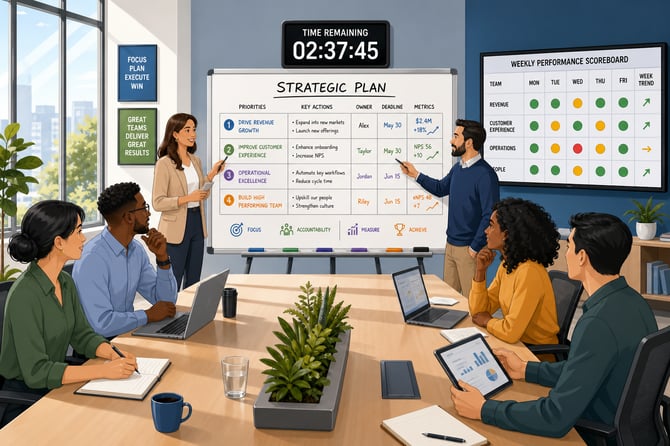
To execute a strategic plan, turn your approved plan into a few owned priorities, a short weekly scoreboard, and a fixed meeting rhythm. Add a monthly loop that shifts people, time, and cash. In the peer advisory boards I run each month, the owners who make this work do the same few things. They assign one owner to each priority, break yearly targets into quarterly and weekly steps, review their measures every week, and correct course fast when the market moves.
Most plans fail in the handoff from "approved" to "Tuesday at 10 a.m." Your job is to build that handoff and keep it alive all year. The sections below walk through the system that does it, with sized examples you can borrow. If you have not written the plan yet, start with how to write a strategic plan, then come back here to run it.
Start with the few priorities you will actually run
Execution starts with a hard choice: you fund a few priorities and you pause the rest. Try to run everything and you spread your team thin, deadlines slip, and client work pays the price. A short list is what keeps the plan in the business instead of on a shelf. If your priorities still feel fuzzy, a structured strategic planning process can force the trade-offs before execution starts.
Picture a 12-person marketing agency with nine live initiatives: a new website, an ABM pilot, a strategist hire, a new project tool, a referral program, case studies, niche positioning, a partner channel, and a margin cleanup. That list guarantees drift. They cut to four that get real backing:
- Margin cleanup
- Project tool rollout
- Case studies for sales enablement
- One niche positioning push
Use a simple capacity rule: one major priority per leader per quarter. Everything else becomes maintenance or a parking-lot item. If no leader can own it this quarter, it waits.
Give every priority one named owner
Execution speeds up when every priority has one named owner. One person stays accountable for the outcome, the dates, and the trade-offs. Everyone else supports. In a 40-person light manufacturing firm launching a new product line, Sales, Ops, and Finance all play a part. You still pick one owner. Make the VP of Ops the owner if the biggest risk sits in tooling, throughput, and quality, then have Sales and Finance feed in their pieces.
- Owner
- Commits to the target, runs the weekly check-in, escalates issues, and asks for help early.
- Contributors
- Deliver defined pieces with dates: pricing inputs, customer targets, the margin model, supplier approvals.
Make ownership visible so it sticks. Post a one-page priority scoreboard where everyone sees it: priority name, owner, two or three measures, next milestone, and a green, yellow, or red status. Keep it inside a meeting cadence your team already respects. You can add this as three short lines to a role without rewriting anyone's job description.
Write a one-page execution charter for each priority
A priority stays alive when its owner runs a one-page charter with clear measures and weekly proof of progress. This replaces long project plans that busy small teams never open. Keep the whole thing to a single page:
- Outcome: the business result, and by how much it changes
- Due dates: start, weekly checkpoints, finish
- Budget: total cap, and who approves overages
- Leading indicators: two to four weekly signals the owner can influence
- First three actions: specific tasks with dates for the next seven days
- Decision rights: what the owner decides alone versus what needs approval
Take a $60,000 website rebuild at a regional plumbing company on a 90-day clock. The outcome is more booked jobs from web leads and fewer missed calls through better forms. Weekly deliverables move from sitemap to wireframes to copy to a dev sprint to QA to launch. Leading indicators are quote requests, call clicks, page speed, and form completion rate. The marketing manager picks the vendor and content; the owner approves any scope change over $5,000.
Turn annual targets into quarterly commitments
Execution gets real when you turn a yearly target into quarter commitments your team can deliver. Account for pipeline lag, seasonality, and capacity. Start with bookings, since revenue follows later. Take a 30-person B2B services firm with a 90-day sales cycle. A $1.2M revenue target needs about $1.5M in new bookings, assuming 80% gets delivered in-year. Demand peaks in Q2 and Q4.
| Quarter | Bookings target | Main move | Trigger |
|---|---|---|---|
| Q1 | $250K | Hold headcount, protect delivery | Backlog over 8 weeks: open one project-manager req |
| Q2 | $500K | Add two billable staff by week 6 | Seasonal demand peak |
| Q3 | $300K | Protect utilization | Pipeline coverage under 3x next-quarter bookings: shift one seller to outbound |
| Q4 | $450K | Hire one seller in early Q3 to feed Q4 | 90-day sales-cycle lag |
The triggers matter as much as the numbers. They tell you when to act before a quarter slips, rather than after.
Break each quarter into weekly actions
Turn each quarterly commitment into a short weekly action list. Give every action an owner, a due date, and one or two measures. Keep it to one page so a 30-minute weekly meeting stays fast. Each Monday, every team lead names one priority-aligned outcome, such as "reduce reopen tickets" or "close two change orders." The page holds your top three priorities, one or two measures each, five to nine weekly actions, and any roadblocks with a next step.
A 15-person ecommerce brand runs it like this. Take returns. The measure is return rate and the top three return reasons. The actions are a new size chart (Ops, Friday) and a fit quiz on product pages (Marketing, Thursday). Now take paid-search efficiency. The measure is ROAS and cost per acquisition. The actions are pausing the ten worst keywords (PPC lead, Wednesday) and refreshing three landing pages (Web, Friday).
Build a meeting rhythm that keeps the plan alive
The plan stays on track when a simple cadence forces decisions, clears blockers, and locks commitments. Skip meeting theater. Keep each meeting short, owned, and action-based. Picture a 22-person construction company juggling eight active jobs plus three growth initiatives:
- 15-minute daily huddle (ops team)
- Today's job risks, safety, material delays, subcontractor gaps. End with who owns each fix by end of day.
- 30-minute weekly execution meeting (lead team)
- Review the five to eight scoreboard measures, decide trade-offs, remove the top two blockers, confirm next week's commitments.
- 60-minute monthly review
- Check initiative progress, budget, and capacity. Stop or re-scope one item if crews are overloaded.
- Quarterly reset
- Reconfirm priorities, reassign owners, and update targets based on cash flow and backlog.
Say the plan in plain language people can repeat
Execution speeds up when your team can say the plan the same way, in one breath. Use one message, three priorities, what changes this week, and how you measure success. Keep it stable for 90 days, then refine it in your review cadence. A clear message looks like this:
- One message: "We grow same-store revenue by keeping more patients and earning more referrals."
- Three priorities: retention, referrals, and schedule access.
- This week changes: two scripts, one dashboard, one owner per location.
- Measures: reappointment rate, referral count, hygiene fill rate.
A 50-person dental group runs this across offices. Each office manager gets a one-page brief and a 10-minute Monday huddle. You give managers room to pick their own tactics while you hold the same standard for the message and the metrics.
Track a short scoreboard that tells the truth
You win by tracking a short list every week, then acting on what moves and what slips. Pick five to nine measures total. Any more and you get a vanity dashboard nobody uses. Mix outcomes, which tell you what happened, with leading indicators, which tell you what you can change this week. A 20-person specialty food manufacturer tracks:
- On-time ship rate (outcome)
- Scrap rate (leading)
- Gross margin (outcome)
- Cash conversion cycle (outcome)
- New account pipeline value (leading)
The scoreboard has to tell the truth in ten seconds. Use a simple green, yellow, red view. Force clarity: every red carries a written cause and a next action with an owner. Optimistic reporting kills execution. People round up. They explain the gap rather than close it. A 28-person logistics company runs a shared sheet of eight metrics. It updates every Friday by 3 p.m., one owner per metric, with two lines each on what happened and what changes next week. Every red gets reviewed Monday.
Tie measures back to roles so the work connects. Take a 35-person IT managed-services firm chasing lower churn. The helpdesk scoreboard tracks first response time, reopen rate, and satisfaction after a ticket closes. Projects track on-time milestones and scope-change cycle time.
Run weekly accountability and unblock fast
Accountability gets real when every owner makes a weekly commitment with a due date and simple proof, then reports back in a tight cadence. You stop chasing. The system does the chasing. In a 10-person professional services firm, the owner runs a 25-minute Monday meeting and a shared commitment log:
- Commitment: one sentence, tied to a quarterly priority
- Due date: day and time
- Proof: client email sent, proposal uploaded, invoice issued, draft in the folder
- Status: green, yellow, or red, plus one blocker
Each person closes with, "By next Monday at 9:00, I will ___." The next week, you review proof, clear blockers, and reset. When a decision stalls, run a time-boxed escalation path so it never dies in someone's inbox:
- Owner solves (48 hours). The owner names the decision, the options, the cost, the risk, and the one thing they need from others.
- Cross-functional solve (next weekly meeting, 15 minutes). Functions show up with numbers and trade-offs. The group picks a path or narrows to two.
- Owner decides (monthly review, 10 minutes). If trade-offs remain, the owner decides and logs it. No recycling the same debate.
At a 45-person printing company, Ops wants a $180,000 press now and Finance wants a longer payback. The weekly meeting narrows it to two scenarios. The monthly review ends it: buy now with a lease, or delay 90 days with a signed volume trigger.
Protect capacity so priorities survive the day job
Execution fails when you agree on priorities but never reserve the time to finish them. Protect execution time the way you protect payroll and customer work. You schedule it, you limit it, and you plan around your seasons:
- Block the time like client appointments. An 18-person landscaping company in peak season reserves two 90-minute blocks each week to build a sales system. Phones route to a lead, crews stay in the field, and the block never gets traded for quick fires.
- Cap work in progress. Allow one strategic build per owner at a time. Park the rest on a visible backlog. Fewer open loops means faster finishes.
- Plan for seasons. Map your year by busy months, cash months, and hiring months. Load heavier execution work into slower windows and keep only maintenance moves during peaks.
Fund the plan with budgets and guardrails
A plan gets real when each priority has a budget, a cash rule, and a pause trigger. Attach budgets to the three to five priorities you will finish this year, not to departments. Each one gets one owner, a total budget, a monthly spend cap, and a cash minimum. That last number protects the business when sales swing.
Take a $3M retail chain approving a $40,000 point-of-sale upgrade at $10,000 a month for four months. The guardrail is a $150,000 cash minimum at month-end. If cash drops under $150,000, the rule is clear: stop the rollout, freeze vendor add-ons, and revisit the scope at the next weekly review. The trigger makes the hard call for you, before the pressure hits.
Run a monthly course-correction loop
Execution stays calm when you run a tight correction loop once a month, on the same agenda, while you keep the year's priorities coherent:
- Assumptions: recheck customer demand, supplier costs, labor, and cash.
- Forecast: update the next 13 weeks of cash and the next 90 days of sales and gross margin.
- Moves: approve one to three reallocations, each with a single owner.
Say a key supplier at a 32-person distributor raises prices mid-quarter. The loop turns that surprise into a plan. You shift one quarter from growth to margin protection. Pause a new-territory hire, tighten discount rules, push higher-margin SKUs, and fund a short customer-communication sprint. Track the outcome and adjust again next month.
Test new ideas with small, gated bets
You can keep innovating while you control risk by running new ideas as small, gated bets. Day-to-day operations stay steady, and you still learn fast. Before you spend real money, score the idea on four checks: strategic fit, customer value, economic viability, and risk. Then give the pilot a tight scope, a dollar cap, success criteria, and stop rules.
A 12-person home-services company runs a 60-day membership pilot with a $5,000 cap. The offer is priority scheduling plus an annual tune-up. Targets are 25 sign-ups, 70% month-two retention, and fewer than three service failures. Stop rules are simple: miss retention by week six or exceed the cap and the pilot ends. If it wins, assign an owner and fold it into weekly actions and tracking.
Reset every quarter and close the year clean
Execution stays alive when you run a quarterly reset that ends work cleanly and starts the next 90 days with clear owners and measures. You get focus, faster decisions, and fewer zombie projects draining payroll. Run a 90-minute agenda:
- Review measures: five to seven numbers, actual versus target, one sentence on why.
- Close projects: mark each one done, stop, or carry. Capture the win and the lesson.
- Decide next quarter: pick three to five priorities that move revenue, margin, or capacity.
- Reassign ownership: one name per priority. Swap owners fast if bandwidth changed.
- Set first-week actions: calendar the first two deliverables before you leave the room.
A 60-person staffing firm closes Q2 with a 12% gross-margin gain. It drops two side projects and resets Q3 around recruiter productivity: weekly submittals per recruiter, time-to-fill, and client mix. Ownership shifts from the general manager to two team leads who run the daily workflow.
Year-end is the same move at a larger scale: close loops. Run December as a working review. Skip the ceremony. A 14-person bookkeeping firm might finish two priorities, such as a new monthly-close checklist and a referral-partner process. It sunsets a half-built client portal that never cleared security. It carries one priority into next year with a new owner and a tighter scope. Document what worked in one page. Then reward follow-through with specific praise, a spot bonus, or time off tied to outcomes.
Make execution a weekly habit
Execution becomes culture when you reinforce the same four behaviors every week. No speeches. Just routines people can count on:
- Visible priorities: three weekly commitments on a board, each with one owner.
- Clean handoffs: everyone agrees on what "done" means for each piece of work.
- Fast decisions: small calls get a same-day yes or no.
- Follow-through: owners close loops early in the week and report back.
A 26-person auto repair chain runs a 30-minute wins-and-lessons review every Friday at 8:30 a.m., tied to a simple scoreboard and one customer metric: comeback rate, or repeat repairs within 30 days. Small, repeated, and visible is what turns a plan into how the business runs.
Frequently asked questions about executing a strategic plan
- Why do most strategic plans fail?
- Most plans fail in the handoff from approved to daily work. The plan sits in a deck while the team runs the business. Execution fixes this with one owner per priority, a short weekly scoreboard, a fixed meeting rhythm, and a monthly loop that moves resources as conditions change.
- How many priorities should a small business run at once?
- Pick three to five priorities for the year and fund only those. A useful capacity rule is one major priority per leader per quarter. Everything else becomes maintenance or a parking-lot item that waits until a leader has room to own it.
- How often should you review a strategic plan?
- Review a short scoreboard every week at the same day and time, run a monthly course-correction loop on assumptions and forecasts, and hold a quarterly reset to close finished work and choose the next 90 days. This rhythm keeps the plan in daily operations.
- What is the difference between writing a strategic plan and executing it?
- Writing the plan sets direction and picks priorities. Executing the plan assigns an owner to each priority, breaks yearly targets into quarterly and weekly work, tracks a few measures, and corrects course as the market moves. Execution is where the plan turns into results.
Put your plan into weekly motion
A strategic plan only pays off when it drives what your team does this week. Want a steady forcing function for owners, cadence, and honest scoreboards? Connect with a local TAB peer advisory board and facilitator and work your execution through with people who run it every month.
For the upstream half of the work, see why strategic planning is essential for business growth.