
 TAB Argentina
 TAB Australia
 TAB Austria
 TAB Canada
 TAB Chile
 TAB Czech Republic
 TAB England
 TAB France
 TAB Germany
 TAB India
 TAB Ireland
 TAB Israel
 TAB Lichtenstein
 TAB Mexico
 TAB Moldova
 TAB Netherlands
 TAB New Zealand
 TAB Paraguay
 TAB Portugal
 TAB Romania
 TAB Scotland
 TAB Slovakia
 TAB South Africa
 TAB Spain
 TAB Switzerland
 TAB United States
 TAB Wales
Summary:
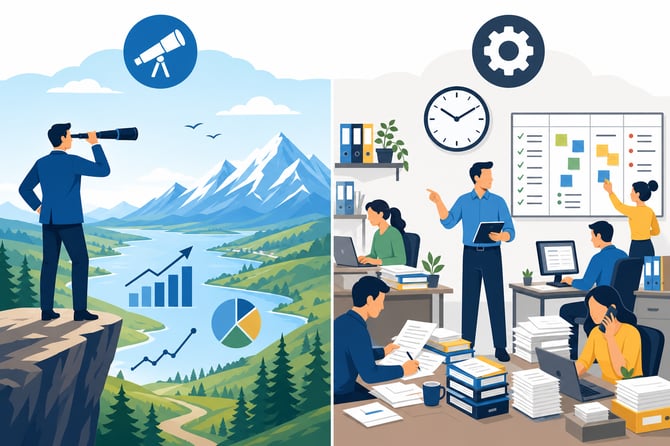
Strategic thinking sets direction. Operational thinking runs today's work. Small business owners need both because each one answers a different question. Strategy asks where the company is going and why. Operations asks what breaks next and how you ship it. Lean too far into one gear and the business stalls. The real skill is shifting between them in a single day.
If you own a 5 to 250 person company, your calendar often picks the gear for you. Fires pull you into operations. Big goals pull you into strategy. The business pays when either gear stays cold too long.
What is the difference between strategic and operational thinking?
The split comes down to three things: time horizon, altitude, and the question you ask.
- Strategic thinking
- Looks 6 to 24 months out or further. It is about choices, tradeoffs, and where to place your bets. It asks, "Where are we going, and why?" See why strategic planning is essential for business growth.
- Operational thinking
- Looks from today out to about 90 days. It is about capacity, quality, cash timing, and clear ownership. It asks, "What breaks next, and how do we ship it?" This is the world of a working operating plan.
| Strategic | Operational | |
|---|---|---|
| Horizon | Quarters, years | Days, weeks |
| Altitude | Market and model | Process and people |
| Inputs | Customer truth, numbers | Workload, bottlenecks |
| Outputs | Priorities, focus | Plans, follow-through |
Here is a quick self-check. If your day fills with approvals and urgent asks, you sit in operations. If you chase new ideas while the basics slip, you float in strategy. Either way, book a 30 minute weekly block to switch gears. Then defend it.
What strategic thinking looks like in a small business
Strategy gets real when it shows up as clear choices. You can explain each one in a minute, then back it with time and cash. When money is tight, it looks like this:
- Market focus. Pick one or two customer types you can win, then stop chasing anyone with a budget.
- Pricing posture. Decide whether you compete on price, speed, or outcomes, and hold that line. Treat pricing as a long-term position, since discounts you mean as a short promo can harden into what the market expects.
- Channel choice. Choose where growth comes from (partners, outbound, referrals, online) and pause the rest.
- Hiring profile. Hire for the bottleneck you plan to break. Skip the loudest gap this week.
Two questions expose your strategy fast:
- What will we stop doing?
- What will we double down on?
You can spot healthy strategic thinking within a week. Meetings end with tradeoffs instead of longer to-do lists. Your team can tell the difference between a strategic plan and a business plan. And you can name your top three bets without checking a document.
What operational thinking looks like day to day
Operational thinking keeps today's promises. It runs the business as a daily machine. Capacity, process, quality, and cash timing all have to line up so work ships on time. You see it in scheduling, throughput, rework, and how fast you reply, quote, and fix issues.
Here the questions shift from "Where are we going?" to three sharper ones:
- What is breaking right now?
- What is slowing us down?
- What must be true by Friday to hit our commitments?
Good operators watch a short owner-level scorecard. These are a few numbers they can act on each week:
- On-time delivery percentage
- Work in progress (WIP) count
- First-pass quality percentage
- Cash in versus cash out this week
Systems beat effort over time. A live scorecard helps you spot waste early and double down sooner, before a small process gap turns into a margin problem.
The two ways owners get stuck in one gear
Most owners default to one gear under pressure and call it being responsive. There are two classic traps. Each one has a clear set of tells.
Trapped in operational firefighting
This is the owner whose strategic gear goes cold. The morning opens with a customer complaint. A quick huddle turns into a hiring debate. Noon becomes inbox triage. By late afternoon you approve a discount to save a deal, even though margins already feel thin.
The cost is real. Growth stalls. Customer experience varies by who caught the issue. Delegation drops because stress drives task hoarding, a pattern TAB Facilitators see over and over. Our work-life balance survey ties the same problem straight to delegation. The fix starts small. Block one protected hour this week to choose the few outcomes operations should serve.
Vision-first, with operations that cannot hold the line
This owner lives in the strategic gear: big moves, bold bets, fresh pivots. The vision is strong, but the daily machine cannot keep up. The tells are familiar. Too many priorities at once, so everything stays half-built. Unclear ownership, so tasks bounce between leaders. Constant reorganizing, so the team learns new boxes instead of new habits.
When operations stays cold, execution breaks fast. Deadlines slip. Projects sit at "almost shipped." Quality wobbles as people guess what "good" looks like. Cash surprises show up when process gaps hit the bottom line. If your energy outruns your capacity, you will hear one question on repeat: which idea wins this week?
How strategic and operational thinking feed each other
Strategic thinking filters what deserves focus. Operational thinking runs the work and reports the truth back. That loop is the whole point, and it runs in four steps:
- Decide. Pick a priority that fits the plan and the customer.
- Run. Execute through people, process, and tools.
- Learn. Watch the constraints, defects, delays, and objections.
- Adjust. Refine the plan and the operating system, then repeat.
Two mini-cases show what happens when the loop breaks. When strategy ignores operations, you promise a 48 hour turnaround your capacity cannot support. Work piles up, quality slips, and the plan becomes a slide deck. When operations ignores strategy, you chase every urgent request, discount, and custom job. Soon you mistake noise for signal and drift off the direction you set.
How to tell which gear you are stuck in
Set a five minute timer. Scan the last two weeks. Score each statement 0 (rarely), 1 (sometimes), or 2 (often).
- My calendar shows at least two hours a week for direction-setting work.
- I spend more time deciding than doing.
- Under stress, I clarify priorities before I jump into tasks.
- Most meetings end with a clear owner, due date, and next step.
- I say no to requests that miss this quarter's focus.
- I track a few outcomes weekly, then adjust based on what I see.
- I let my team solve issues that a clear rule would cover.
- I improve a process at least once a week.
- I can explain our top three bets in one minute.
- I catch small process gaps before they hit the bottom line.
Add up your score, then read where you land:
- 0 to 7
- Stuck in operations. Common at 5 to 50 employees.
- 8 to 14
- Mixed gear. Common at 50 to 150 employees.
- 15 to 20
- Strategy heavy. Common at 150 to 250 employees.
Sharp owners still get this wrong, because busy feels productive. Peers tend to catch your default gear faster than you do. They see the pattern from outside your inbox.
How to protect strategic thinking time when operations screams louder
Operations will always win the calendar if strategy stays optional. Three habits keep the strategic gear warm without waiting for a free week.
Make the block non-negotiable. Set two 45 minute strategy blocks each week, same days, same time. Treat them like a key customer meeting. Name each block for its outcome, such as "Q3 capacity decision" or "pricing direction." Keep the agenda to one question, one decision, one next step. If you must move a block, reschedule it within 48 hours or it counts as missed.
Delegate decisions before tasks. If every approval, exception, and escalation routes to you, you stay stuck in operational mode. Hand off decision rights first, then the work. Run a simple cadence so nothing slips:
- Daily check (10 minutes): metrics, blockers, owner-only escalations.
- Weekly review (45 to 60 minutes): priorities, capacity, handoffs.
- Monthly reset (90 minutes): goals, process fixes, key risks.
Borrow outside accountability. Pick one person who sees the strategy block and defends it. Give them permission to ask, "What did you decide?" This works because other owners spot your abandoned gear quickly. They hold you to the reset.
This is the exact blind spot owners surface in a TAB peer advisory board. Other owners can see which gear you have dropped faster than you can. One member put the payoff plainly:
I really benefited from preparing monthly presentations of issues and challenges to my TAB board. Receiving great insights and new perspectives helped me clarify my ideas. As a result, I implemented strategic planning, key performance indicators, and other metrics that helped me zero in on the most important elements of running a successful business.
Strategic vs operational thinking: frequently asked questions
- What is the difference between strategic and operational thinking?
- Strategic thinking works months and years out and asks where the company should go and why. Operational thinking works in days and weeks and asks what breaks next and how you ship it. One sets direction and tradeoffs. The other runs capacity, quality, and cash timing so the work gets done.
- Can a small business owner do both strategic and operational work?
- Yes, and most owners have to. The skill is shifting between the two gears on purpose instead of letting the calendar pick for you. Protect a fixed weekly block for strategic thinking. Then delegate enough operational decisions that the daily machine keeps running while you step back to set direction.
- How much time should an owner spend on strategic thinking?
- A useful floor is two hours a week, booked as fixed blocks you treat like a key customer meeting. Owners of larger teams spend more. The point is steady habit over volume. A protected hour every week beats a rare off-site day that operational fires keep pushing off the calendar.
- What happens when a business owner only thinks operationally?
- Growth stalls because no one is choosing where the company goes next. The owner becomes the bottleneck, approving every call while the team waits. Customer experience gets uneven, delegation drops, and small process gaps quietly drain profit. The business stays busy while it slowly loses direction.
Get an outside read on your missing gear
You cannot always see which gear you have dropped from inside your own week. A TAB peer advisory board gives you a room of owners who can. They help you hold your strategy time and follow through on operations. Find a TAB board near you and get that mirror.